Four migrant worker advocacy groups urge sweeping Employment Act reforms to strengthen worker protections
Four labour advocacy groups have proposed sweeping amendments to Singapore's Employment Act, calling for stronger protections for migrant and lower-wage workers, expanded wage recovery mechanisms, improved enforcement, and a pathway towards a universal minimum wage framework.
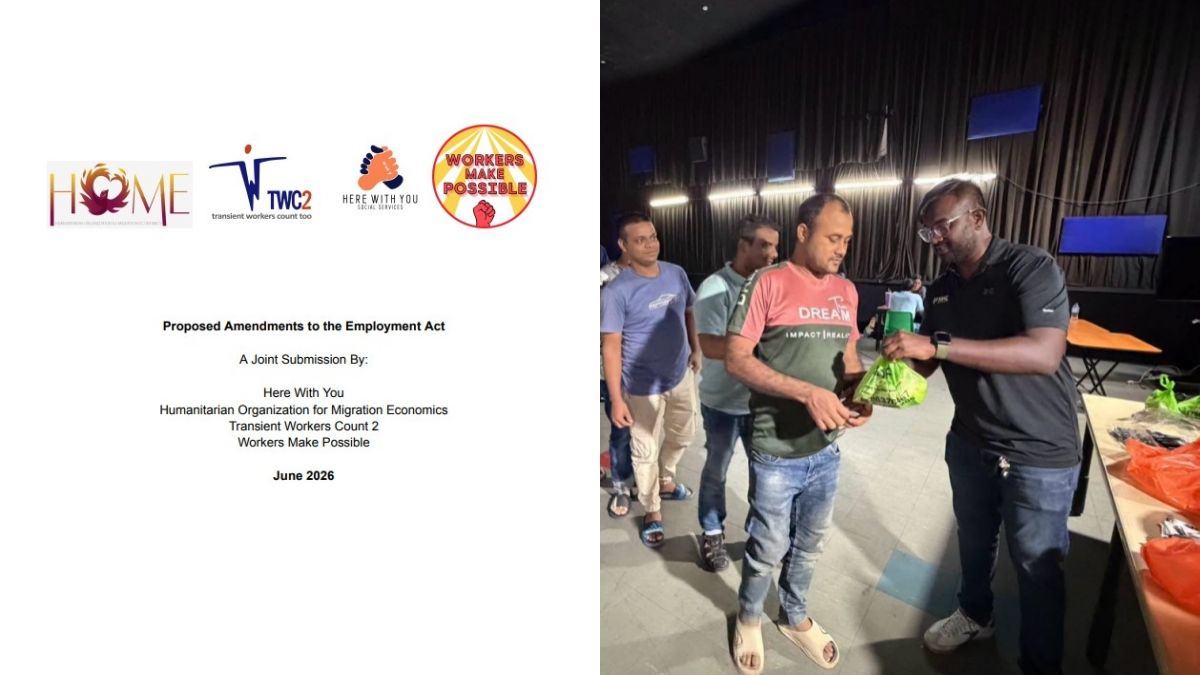
- Four advocacy groups submitted proposed Employment Act amendments to strengthen protections for migrant and lower-wage workers.
- The proposals include a 40-hour work week, stronger wage enforcement and expanded worker entitlements.
- The groups also urged Singapore to establish wage protection mechanisms and work towards a universal minimum wage.

A coalition of four migrant worker and labour advocacy groups has submitted a set of proposed amendments to Singapore’s Employment Act (EA), calling for reforms they say are needed to close “long-standing structural gaps” in protections for lower-wage local and migrant workers.
The report, titled “Proposed Amendments to the Employment Act”, was jointly submitted by Here With You, the Humanitarian Organization for Migration Economics (HOME), Transient Workers Count Too (TWC2), and Workers Make Possible. The submission was sent to the Ministry of Manpower (MOM) in mid-June 2026.
The submission comes as MOM conducts a review of the EA. The review was announced in August 2025, alongside the formation of a tripartite workgroup – comprising government, union and employer representatives – to develop recommendations. According to HOME, this marks the first review of the Act since 2018. MOM has said it will publish the review’s findings in the second half of 2026.
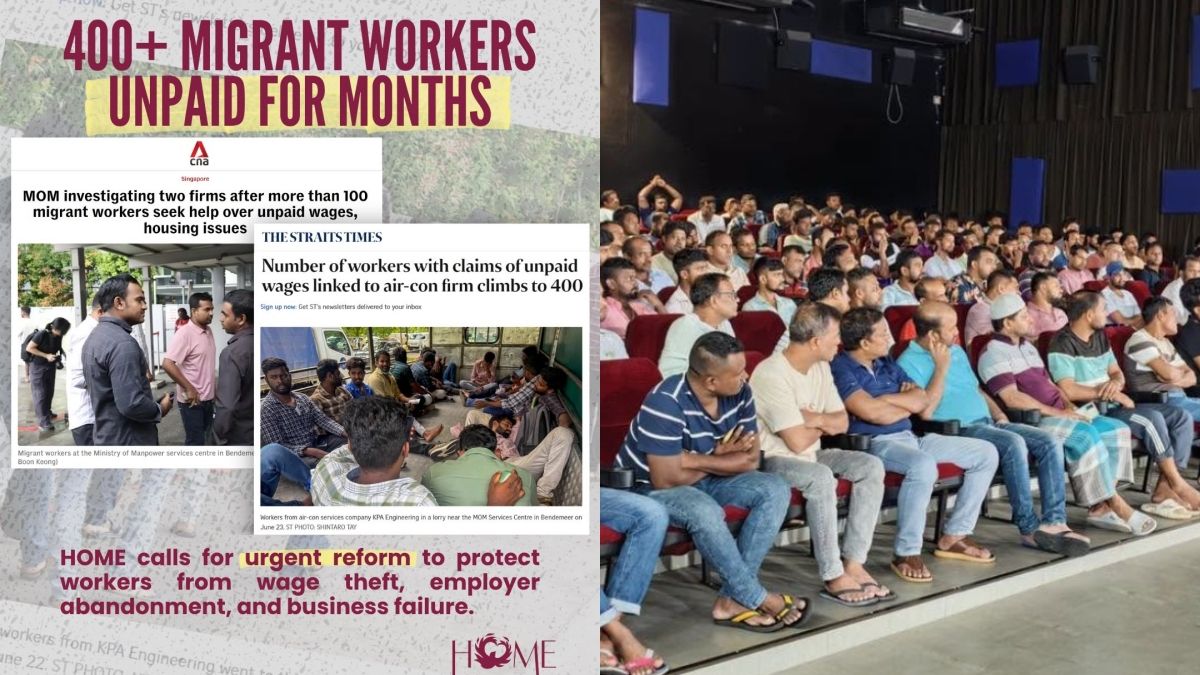
In a series of Facebook posts explaining the submission, HOME said the proposals were prompted by recurring, often unreported cases of wage theft. “You’ve probably seen the headlines about the 400+ migrant workers from three companies who recently came forward over unpaid wages. But wage theft does not always make the news. Instances of wage theft point to deeper systemic issues relating to lack of worker protection and access to remedy,” the group wrote, referring to the ongoing wage dispute involving KPA Engineering, SK Industries and VVR Plant Engineering.
“As the Act undergoes review for the first time since 2018, this is an important opportunity to strengthen protections and address long-standing structural gaps that disproportionately affect lower-wage local workers as well as migrant workers,” HOME added, noting that the series of posts would break down what the Employment Act is and the reforms the groups are calling for.
In the report, the groups said their recommendations were largely drawn from their casework experience with migrant workers, and were organised around four objectives:
- Improving worker wellbeing by enhancing clarity and fairness in core employment terms, strengthening safeguards against excessive working hours, and ensuring timely and transparent salary payment.
- Closing protection gaps that disproportionately affect vulnerable groups, including migrant workers, by addressing exclusions, ambiguities, and structural barriers to enforcement.
- Strengthening enforcement mechanisms by increasing penalties where necessary, improving investigative powers, and promoting greater transparency and accountability in regulatory action.
- Aligning Singapore’s labour standards with contemporary expectations of decent work, including international best practices on documentation, dispute resolution, and protection from retaliation.
The groups said the reforms were meant not merely to update the wording of the EA, but to reinforce its “foundational purpose”: to provide “meaningful, accessible, and enforceable minimum standards that uphold dignity, fairness, and security in the workplace for all workers in Singapore”.
The EA is Singapore’s primary labour law, setting out baseline protections such as minimum terms of employment, salary payment, hours of work, rest days, leave entitlements and avenues for dispute resolution. The report noted that because changes to the Act can “recalibrate the balance of rights and obligations across the labour market”, amendments carry system-wide consequences – particularly for the large population of migrant workers whose work permits remain tied to their employers.
Central to the submission is a proposal to cut Singapore’s statutory maximum working week from 44 hours to 40 hours. Under Part IV of the EA, workers covered by its provisions can currently be required to work up to 44 hours a week – typically a 5.5-day week of eight hours a day, plus four hours on a sixth day – before overtime is payable.
The groups noted that when the EA was enacted in 1968, the 44-hour threshold was applied uniformly to all workers to remove a discrepancy in which white-collar employees had a 38-hour week while blue-collar employees worked 44 hours. But Singapore’s civil service moved to a five-day week in 2004, and many professionals now work five-day weeks by contract or practice, while lower-wage employees and manual labourers largely remain on 5.5-day weeks. The report argued this effectively “reinstat[ed] discrimination between white-collar and blue-collar employees that was once removed in 1968”.
The groups also linked the proposed 40-hour cap to overtime transparency, arguing it would align with the standard five-day week and eight-hour day, removing the current “mismatch” in which overtime is only triggered after 44 hours – a gap they said has contributed to payroll disputes for workers who rely on overtime pay.
The submission also proposes standardising pay for work performed on rest days at two days’ salary, regardless of whether the work was requested by the employer or the employee. Currently, workers are entitled to two days’ pay if the employer initiates the request, but only one day’s pay if the work is deemed employee-requested. The groups called this distinction “a legal fiction that ignores the inherent power imbalance in employment relationships”, noting that migrant workers on work permits tied to a single employer may feel pressured to “volunteer” for work despite lacking a meaningful ability to refuse.
On enforcement, the groups called for higher penalties against employers who fail to issue itemised payslips, Key Employment Terms (KETs) and employment records – documentation that has been mandatory since 2016, but which they said is enforced with an inadequate “light-touch” approach, with penalties as low as S$100.
The report cited 2024 data showing that one in 10 Work Permit holders did not receive itemised payslips at all, while one in six received them inconsistently, leaving many workers without the primary evidence needed to substantiate wage theft claims.
The groups further proposed requiring employers to pay salaries directly into workers’ bank accounts whenever requested, arguing this would create clearer records in disputes involving undocumented deductions or allegations that workers were made to sign blank payslips on arrival in Singapore.
Such a requirement currently exists only under the Employment of Foreign Manpower Act (Work Passes) Regulations; the groups want it written into the EA itself so that breaches are treated as statutory offences.
On leave, the report proposed extending the right to encash unused annual leave to workers who resign, not just those dismissed for reasons other than misconduct as is currently the case.
The groups argued the current exclusion assumes resigning employees will simply use up their leave during their notice period, but that the EA is unclear on whether employers can reject leave requests during notice – creating ambiguity and unnecessary disputes.
The groups also called for doubling the statutory minimum annual leave entitlement from seven to 14 days, arguing seven days is “insufficient by modern standards”, particularly for migrant workers in physically demanding sectors such as construction, shipyard work and domestic services, where fatigue and stress accumulate quickly and additional leave would help them manage their physical and mental health.
Another proposal calls for scrapping the current three-month waiting period before employees become eligible for paid sick leave, arguing that denying sick leave in the early months of employment forces workers to choose “between health and income” and increases safety risks in high-risk sectors such as construction, marine work and manufacturing, where “fatigue, lethargy and lack of concentration may increase the risk of serious or even fatal injuries”.
The submission devotes significant attention to access to justice. One proposal calls for extending the deadline to file wrongful dismissal claims at the Tripartite Alliance for Dispute Management (TADM) from one month to three months.
The groups argued a one-month window is too short for employees who are typically preoccupied with financial distress and job-hunting immediately after being dismissed, and often unaware of their rights within that time. For the approximately 874,000 Work Permit holders covered by the EA, they said the problem is compounded because workers whose employers deny a job transfer must leave Singapore almost immediately.
They cited MOM data showing that foreign employees file four times as many salary claims as local workers, but only half as many wrongful dismissal claims – a gap they attribute to the tight filing window.
The groups also proposed extending the maximum claim period at the Employment Claims Tribunal (ECT) from one year to two years, arguing that low-wage migrant workers often only become aware of unpaid salaries or wrongful deductions well after the fact, typically after seeking advice from non-governmental organisations, and need a more realistic window to pursue claims.
Separately, the report proposed extending the deadline to file post-employment salary-related claims from six months to 12 months after a worker’s last day of employment, noting that migrant workers often need extra time after leaving a job to obtain records, seek legal advice and establish whether they were underpaid – particularly when contracts are withheld or salaries are paid in cash.
The groups also called for equalising and raising ECT salary claim limits. Currently, non-unionised workers are capped at S$20,000, while union-assisted workers can claim up to S$30,000. The report proposed raising the annual limit to S$30,000 for all workers regardless of union status, with a total claimable amount of S$60,000. “Access to statutory dispute resolution should not depend on union membership status,” the groups wrote, noting that many vulnerable workers – including migrant labourers and platform workers – are not union members.
On enforcement of tribunal outcomes, the report said settlement agreements and ECT orders often fail to translate into actual payment because the burden of enforcement falls largely on workers themselves. It called for more proactive prosecutions, stronger penalties, faster recovery mechanisms, and barring directors of companies with unpaid salary liabilities from registering new businesses.
The report devoted significant attention to what happens when employers become insolvent, proposing either a statutory wage protection fund or mandatory wage recovery insurance to compensate workers when companies collapse.
It noted that liquidation proceedings can take years, and that existing support schemes are patchy: citizens and permanent residents may access the means-tested SkillsFuture Jobseeker Support (JSS) scheme, which is capped at workers earning S$5,000 or less and requires an online application with a three-to-six week wait for payouts, while migrant workers can only turn to the discretionary Migrant Workers’ Assistance Fund (MWAF).
The report referenced parliamentary questions raised in January 2026. MP He Ting Ru had asked whether MOM would consider a “statutory fund to provide financial support without means testing to workers of all nationalities during periods of corporate liquidations and bankruptcies”, to which MOM responded that local workers could access the JSS scheme and migrant workers could approach the Migrant Workers’ Centre.
MP Gerald Giam separately asked how many workers had received payouts from TADM’s Short Term Relief Fund (STRF), and whether MOM would consider amending the Insolvency, Restructuring and Dissolution Act 2018 to prioritise employees over secured creditors, mandate wage recovery insurance, and hold directors personally liable for unpaid salaries. MOM said “eligible lower income workers” could access the STRF – a scheme the report noted is only accessible to local workers.
“No worker should be denied their owed wages regardless of their income or nationality,” the groups wrote, arguing that wage recovery insurance is “direly needed” to protect workers during insolvencies and bankruptcies.
The submission also called for formally recognising migrant domestic workers (MDWs) under the EA. MDWs are currently covered only by the Employment of Foreign Manpower Act, which the groups said offers only vague protections – adequate food and rest, and acceptable accommodation – without the baseline protections other workers receive, including annual leave, limits on working hours, overtime pay, and the ability to resign by giving notice.
The groups said the issue was increasingly urgent given Singapore’s growing reliance on MDWs for eldercare in an ageing society. “Without clear limits on working hours or accessible exit options, MDWs may be expected to remain constantly on call,” the report warned, citing risks of chronic overwork, exhaustion and burnout.
The report concluded by calling on Singapore to work towards a universal minimum or living wage covering all workers, including migrants, by extending the Local Qualifying Salary framework and Progressive Wage Model protections to migrant workers.
It noted that some migrant workers earn salaries “as low as S$400 per month” and often face exorbitant recruitment fees that leave them vulnerable to exploitation. A universal wage floor, the groups argued, would reduce in-work poverty and prevent labour standards from being undermined through differential treatment of migrant workers.
The groups concluded that the proposed reforms would help Singapore “reinforce its commitment to fair employment, social cohesion, and sustainable economic growth” while ensuring no worker is left behind “in an evolving labour market”.
The proposals arrive as a wage dispute involving more than 400 migrant workers across three related companies – KPA Engineering, SK Industries and VVR Plant Engineering – has intensified scrutiny of Singapore’s wage recovery system.
The dispute first came to public attention on 22 June 2026, when more than 100 migrant workers presented themselves at the Ministry of Manpower (MOM) service centre in Bendemeer reporting unpaid salaries.
The number of affected workers subsequently rose to approximately 400 across the three companies, all linked to a common director, Ramu Palani Velu, an Indian national and Singapore permanent resident.
He returned to Singapore and surrendered his passport to authorities on 28 June, and is assisting with investigations, according to Minister of State for Manpower Dinesh Vasu Dash.