Humanoid robots make combat debut at world's first freestyle robot fighting tournament in China
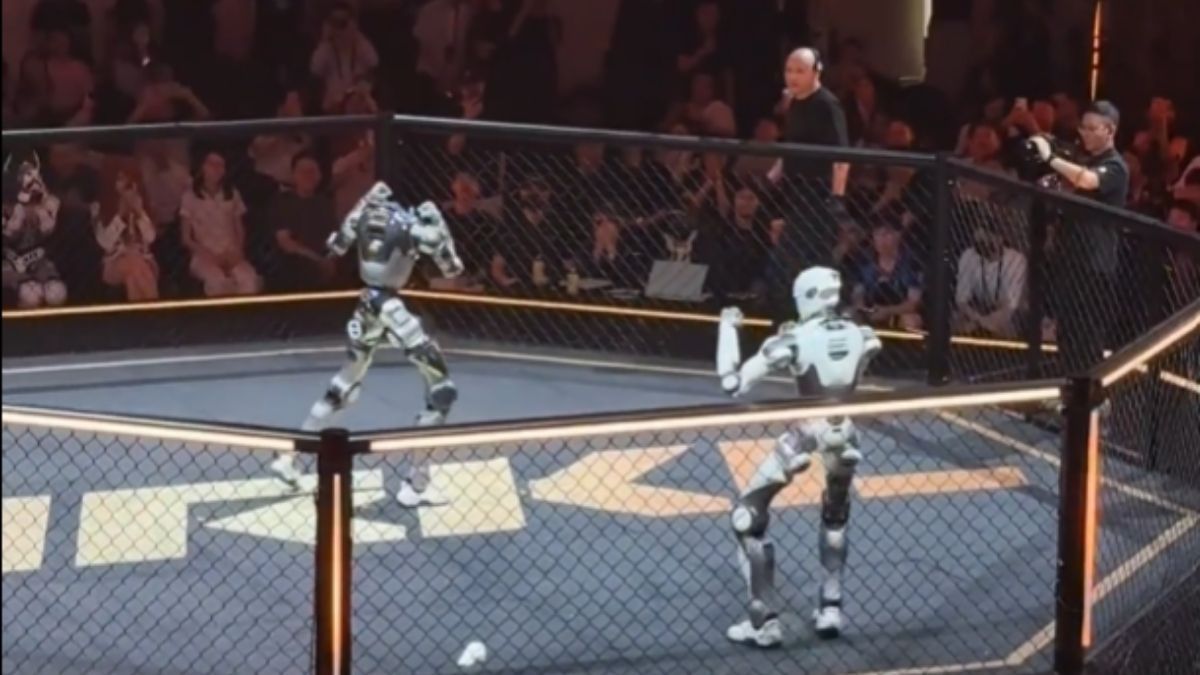
Humanoid robots exchanged punches, kicks and evasive manoeuvres in Shenzhen as China launched what organisers described as the world's first freestyle humanoid robot fighting tournament to advance robotics research and commercialisation.
- Shenzhen hosted what organisers described as the world's first freestyle humanoid robot fighting tournament.
- International teams competed using identical humanoid robots with customised software and protective modifications.
- EngineAI said competition data will support robotics research and accelerate commercial development.

Humanoid robots traded punches, kicks and evasive manoeuvres before a live audience in Shenzhen on Thursday as China staged what organisers described as the world's first freestyle humanoid robot fighting tournament, an event intended to test advanced robotics technologies while promoting their commercial development.
The competition, known as the Ultimate Robot Knock-out Legend (URKL), was organised by Chinese robotics company EngineAI at the Shenzhen Nanshan Cultural and Sports Centre in south China's Guangdong province.
International teams compete on a level playing field
More than 200 teams from 10 countries entered the competition before online qualifying rounds reduced the field to 32 finalists.
Rather than allowing teams to build completely different machines, organisers required every competitor to use EngineAI's full-sized humanoid T800 robot as the standard platform. Teams instead focused on developing customised armour and engineering improvements to enhance performance.
According to Guangdong News, participating institutions included the University of California, Berkeley, Stanford University, Tsinghua University, Zhejiang University and the University of Hong Kong. The competition offers a total prize pool of 10 million yuan (about US$1.48 million).
Combat designed to evaluate technology, not brute force
Organisers said the tournament was intended to assess a broad range of robotic capabilities rather than simply determine which machine could strike the hardest.
Robots were judged on motion control, balance algorithms, perception, decision-making, power systems and structural protection. Under the URKL rules, scores also reflected effective strikes, body stability, defensive and evasive ability, and overall durability.
The robots exchanged punches, kicks and defensive manoeuvres throughout the matches, according to information shared by organisers with the Global Times.
One of the competition's most dramatic moments came when a robot lost its head during a bout but continued fighting using torso-based core systems after its head-mounted sensing functions failed. Organisers said the incident highlighted the machine's durability and resistance to impact, the Guangzhou Daily reported.
EngineAI said the T800 stands 1.73 metres tall and can perform movements including uppercuts, spinning kicks and rapid recovery after falling, supported by posture control, dynamic perception and shock-absorbing systems.
EngineAI sees competition as research platform
EngineAI founder and chief executive Zhao Tongyang said the competition was designed to accelerate technological development while helping establish a globally recognised humanoid robot sporting brand.
"We want to use competition to drive research and industry development," Zhao said. "Let the event feed back into technology, and let technology drive the industry."
He said data collected from real combat scenarios would help validate technologies such as mechanical structural balance, millisecond-level intelligent decision-making and multimodal sensor coordination, accelerating the transition of humanoid robots from laboratory prototypes to commercial applications.
The company announced in May that it had established a 12,000-square-metre manufacturing base with the aim of producing up to 10,000 units of its flagship T800 robot.
Founded in October 2023, EngineAI has rapidly expanded its production capability.
"From our first test machine in 2024, to the small-scale production of hundreds of PM01 units in 2025, and now to the qualitative leap toward a 10,000-unit delivery capability, we are entering a new phase of industrialisation and commercialisation," Zhao said
Film star attends opening event
Martial arts actor Donnie Yen attended the opening ceremony after appearing in an EngineAI promotional campaign ahead of the event.
"Honestly, I used to see robot fighting only in science fiction movies," Yen said. "But today, for the first time, I got to watch real robots fighting up close. Witnessing this historic breakthrough firsthand was completely different. The weight of the machines, the precision of their movements — it was incredible."
According to Chinese media outlet China Focus, the 2026 URKL season will continue through the end of the year, with the Shenzhen tournament serving as the opening event in a series that will determine the overall champion.