Bottle rejected by BCRS machine despite 10-cent label, sparking scheme complaints
A Complaint Singapore member's video of a Beverage Container Return Scheme machine repeatedly rejecting a labelled bottle has drawn hundreds of comments, ranging from technical tips to accusations that the 10-cent deposit scheme is a money-making exercise.
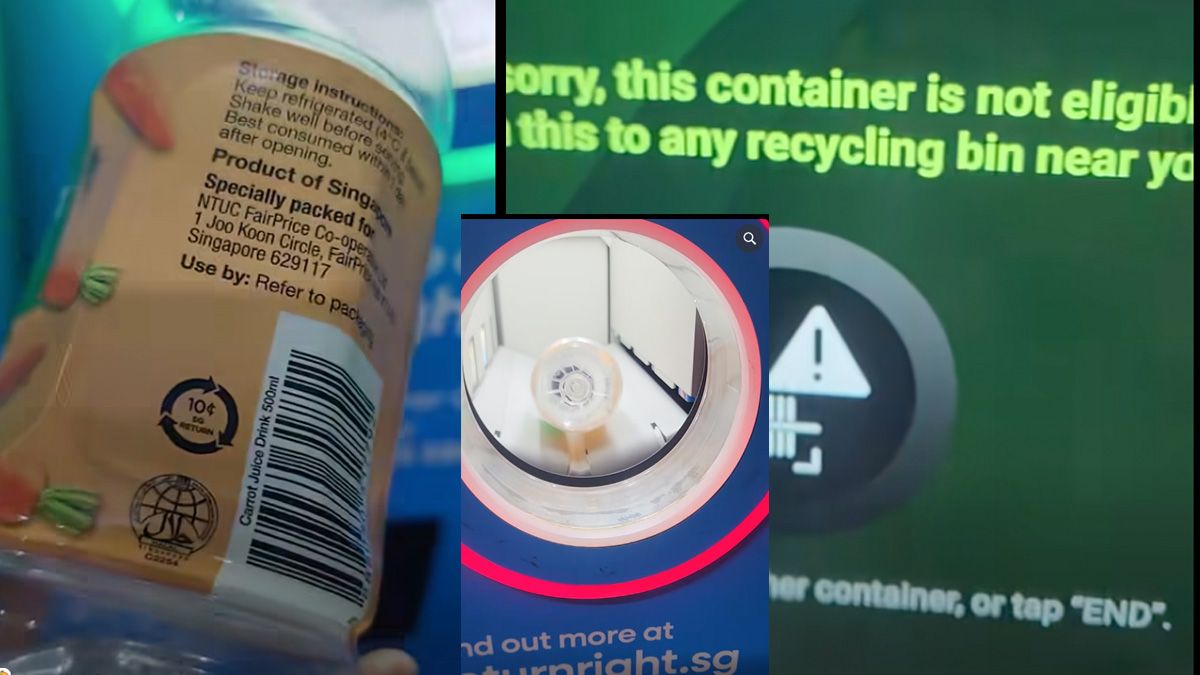

A video posted to the Facebook group Complaint Singapore has drawn hundreds of comments after a member showed a Beverage Container Return Scheme (BCRS) machine repeatedly rejecting a drink bottle that appeared to carry the eligible 10-cent return label.
The member, posting on 21 July 2026, wrote that he had deposited a bottle marked with the 10-cent recyclable label, but the machine kept rejecting it.
"Can anyone advise me what went wrong? I deposited a 10ct recyclable bottle into machine and it kept rejecting. Bar code was intact and the 10ct return..." the post read, before being cut off.
The accompanying footage showed a machine screen displaying an error. The message stated the container was not eligible and advised the user to take it to a recycling bin, or to insert another container and tap "END".
A timestamp on the machine display read 20 July 2026, and the footage showed the bottle in question, a carrot juice drink specially packed for NTUC FairPrice Co-operative. The label carried a "10¢ SG Return" mark and an intact barcode.
Technical suggestions
Many commenters offered practical advice on how to get the machine to accept the container.
Several suggested inserting the bottle bottom-first, or ensuring the barcode faced a particular direction so the sensor could read it.
One commenter advised rolling the wrapper so the barcode sat on a flat surface, noting the code is often printed across the curved edge of the bottle.
Another wrote that the machine's sensor was positioned to one side, and that the barcode needed to face left or right rather than up or down.
Other commenters suggested emptying any remaining liquid, wiping the barcode, or cancelling and restarting the transaction.
Some pointed to the label itself. One commenter said certain containers lacked the specific 10-cent return logo required for a refund, while others speculated the bottle was not registered for the scheme.
The official Return Right website, operated by BCRS Ltd, lists the conditions under which machines will not accept a container. These include a missing Deposit Mark, a damaged or unreadable barcode, a damaged or unreadable 2D-matrix code sticker, a crushed or out-of-shape container, or a non-eligible item such as glass, a carton or a pouch.
The footage posted to Complaint Singapore appears to show a container bearing the deposit mark and an intact barcode, a circumstance the website's self-help guidance does not directly address. The site does not explain why a container meeting the stated eligibility conditions might still be rejected.
The website advises that where a refund is unsuccessful, users may claim a manual refund by photographing the machine screen or service ticket, emailing the image to the operator with their name and bank details, and waiting up to 30 business days for processing.
Frustration and accusations
A large share of the responses expressed frustration with the scheme rather than the individual transaction.
Numerous commenters described the scheme as a "scam" or a "failed project", with several alleging it was designed to collect 10-cent deposits that would go unrefunded.
One commenter wrote that the initiative amounted to marking up drinks by 10 cents while making refunds difficult to obtain.
Several respondents said they had stopped buying bottled drinks carrying the deposit, or had switched to alternatives to avoid the process.
Others reported similar experiences of machines accepting a bottle without issuing a refund, or providing a slip directing them to email or call for reimbursement.
Some responses named political office-holders associated with environmental policy, expressing displeasure at the scheme's implementation. Several comments were dismissive or abusive in tone.
The claims made by commenters are their own views and have not been independently verified.
Background to the scheme
The BCRS launched on 1 April 2026. It offers a 10-cent refund for eligible plastic and aluminium drink containers returned to collection machines, of which more than 1,000 have been installed across Singapore.
According to a report by Mothership, a bottle qualifies for the refund only if it bears the BCRS logo, which indicates that beverage manufacturers or importers have paid 10 cents into the scheme for that unit.
That 10 cents is passed to the retailer and then to the consumer at the point of sale. A container without the logo means no deposit was paid, and no refund is available.
The Mothership writer, who tested the machines, reported that the process was generally straightforward but that one of three attempts failed, with the machine taking the bottle without issuing a refund.
Recovering that lost 10 cents required two emails and about two weeks, the writer reported, after the scheme operator, BCRS Ltd, gathered bank details and processed a manual refund.
The writer also noted that some labels on packaging suggest general recyclability, which consumers may confuse with BCRS eligibility, and that the machine interface presumed familiarity with digital tools such as PayLah! QR codes.
In response to queries from Mothership, a BCRS Ltd spokesperson said each manual refund case was treated as a learning opportunity that highlighted where systems could be made more robust.
The spokesperson said the majority of returns and digital refunds were successfully processed at the Return Right machines, and that members of the public encountering issues could submit transaction details to the operator for assistance.
The scheme's transition period runs until 30 September 2026. After that date, all beverage containers sold in Singapore will be legally required to carry the BCRS label, and returns will become the standard route for such containers.
The scheme forms part of wider efforts to raise recycling rates ahead of the government's 2030 Zero Waste Plan target. Singapore's only landfill, Pulau Semakau, is estimated to be full by 2035.