Hong Kong police stage counter-terror drill at library nine days after crackdown on independent bookstores
A Hong Kong police counter-terrorism drill at the city's Central Library has drawn criticism online, coming nine days after national security police raided two independent bookstores and arrested five people.
- Hong Kong police staged a counter-terrorism exercise at the Central Library involving more than 150 participants.
- The drill came nine days after five people were arrested during raids on two independent bookstores.
- Critics linked the timing to Hong Kong's broader national security crackdown on booksellers and publishing activities.

Hong Kong police have conducted a counter-terrorism exercise at the Hong Kong Central Library, prompting online criticism over the choice of venue and its timing, coming just nine days after national security police raided two independent bookstores and arrested five people.
The exercise, code-named GREATWILL, was held on 24 July 2026, according to a Facebook post published by the Hong Kong Police Force on 25 July.
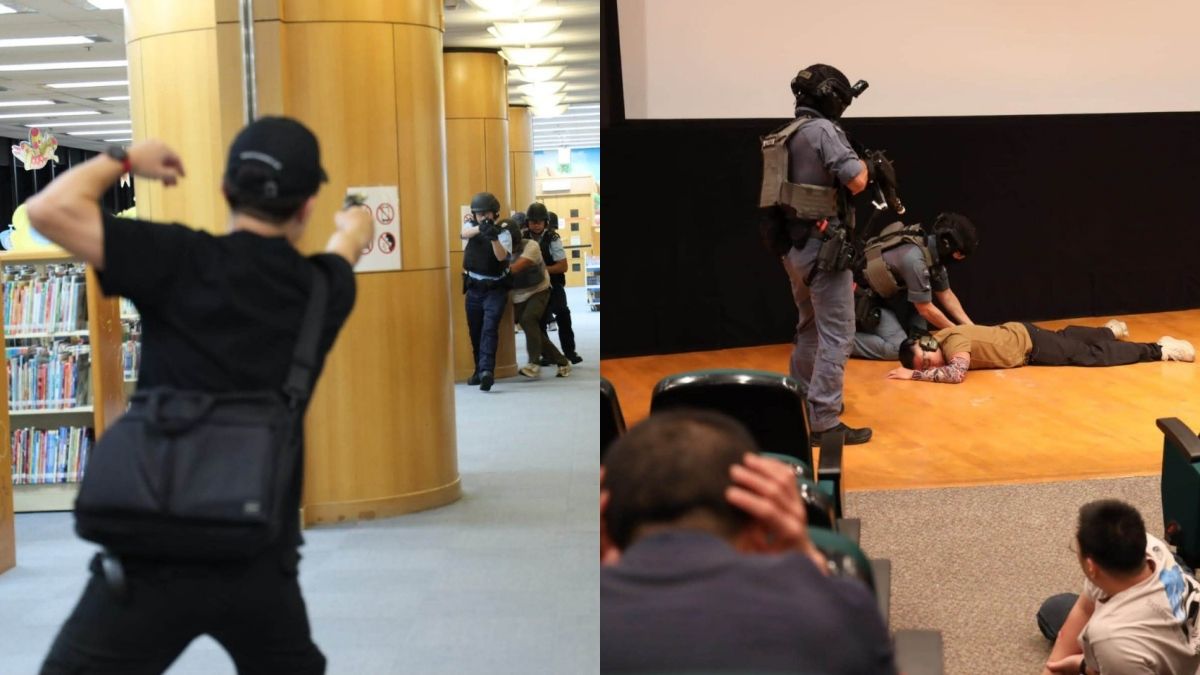
The drill involved more than 150 participants, including officers from the Hong Kong Island Regional Command, the Emergency Unit of the Hong Kong Island Region, Wan Chai Police District, the Police Tactical Unit and the Counter Terrorism Response Unit.
Participants also included staff from the Central Library and students taking part in the police force's Police Mentorship Programme.
According to police, the exercise was designed to strengthen frontline officers' ability to respond to terrorist attacks and improve communication and co-ordination between police and other stakeholders.
The scenario simulated several terrorists entering a venue where a seminar was being held and launching an attack, causing chaos and leaving several people injured.
Police said officers rapidly arrived at the scene, carried out an immediate tactical intervention, subdued all the simulated terrorists and safely evacuated people from the venue in an orderly manner.
The force said the exercise was intended to allow students to experience emergency response procedures directly and bring greater awareness of crisis response into schools.
Why the Central Library was chosen
Police said the Central Library was selected because it is an important landmark in Hong Kong and could provide a realistic environment for simulating a terrorist attack.
The force said the location allowed police and other stakeholders to practise communication, co-ordination and emergency planning under conditions resembling those of a real incident.
According to police, conducting the exercise in an actual public setting would help frontline officers improve their overall response to terrorist attacks and ensure they could act quickly and effectively during a genuine crisis.
Police also reminded the public to follow the "Run, Hide, Report" guidance, referred to in Chinese as "閃、避、求", if they encounter an unexpected attack.
The exercise nevertheless generated critical reactions online, with some users questioning why a library had been selected as the setting for a simulated terrorist attack.
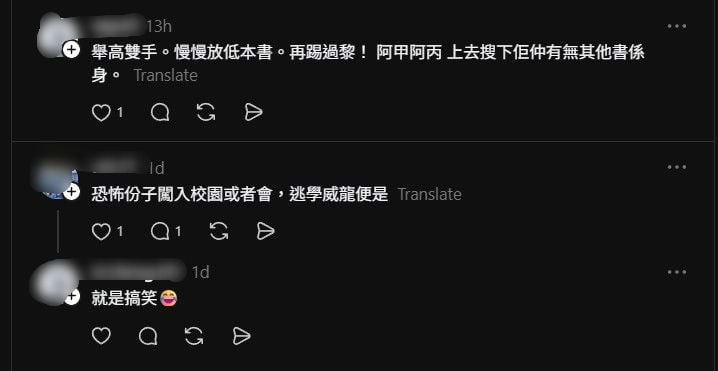
Some mocked the scenario by joking: "Put down the book slowly, raise your hands, and kick the book over!"
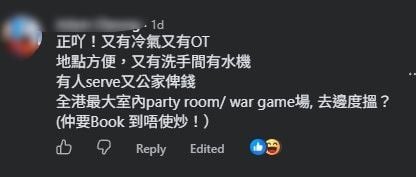
Another sarcastically asked whether the exercise had turned the library into a "war game arena", while other comments suggested the venue may simply have been selected because it offered air conditioning, water dispensers and other convenient facilities.
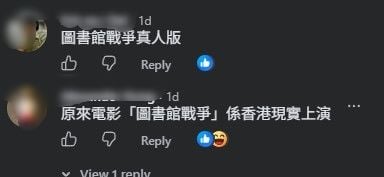
Several users compared the exercise with Library Wars, a Japanese novel and film series depicting conflict over censorship and access to books.
"It turns out Library Wars is being acted out in real life in Hong Kong," one comment said.
Bookstores under national security scrutiny
The Central Library exercise took place against the backdrop of three rounds of national security enforcement action involving four independent bookstores within less than four months.
On 24 March, national security police searched Book Punch on Tai Nan Street in Sham Shui Po and arrested its owner, Pang Yat-ming, and three female employees.
Police alleged that the four had breached Article 24 of the Safeguarding National Security Ordinance by knowingly selling publications with seditious intention.
Books seized during the operation reportedly included The Biography of Jimmy Lai, written by Kei Fook.
On 24 June, national security police searched Hunter Bookstore in Sham Shui Po and arrested a 33-year-old woman and a 32-year-old man.
Police alleged that the pair were involved in displaying items with seditious intention, selling publications with seditious intention and receiving multiple remittances from foreign political organisations.
The investigation also involved alleged property offences under the Organised and Serious Crimes Ordinance.
Police said books, items and documents were seized from the bookstore and a residence.
The latest operation took place on 15 July, the opening day of the Hong Kong Book Fair.
Following a referral from customs officers, national security police searched Left Book House and Tian Yuan Bookstore on Sai Yeung Choi Street South in Mong Kok.
Three women and two men were arrested.
Police said customs officers had found printed materials allegedly containing seditious content in consignments sent from overseas.
Following an investigation, police alleged that the five people had displayed the relevant items and sold publications that were said to incite hatred against the Hong Kong Special Administrative Region Government, the judiciary and law enforcement agencies.
Police seized multiple batches of books from the two bookstores.
The three operations involving Book Punch, Hunter Bookstore, Left Book House and Tian Yuan Bookstore resulted in 11 arrests in total.
The timing has drawn particular attention because the 15 July bookstore raids and the 24 July Central Library exercise were separated by only nine days.
Questions over the absence of a banned-books list
The bookstore raids have also renewed debate over how booksellers are expected to determine what material may expose them to national security risks.
Security Secretary Chris Tang has said the government does not intend to establish a list of banned books.
The government's position, as described by Tang, is that authorities target the content of publications rather than their titles, while booksellers have a responsibility to ensure that materials they sell do not endanger national security.
Tang has compared the responsibility to food safety, arguing that sellers must ensure the products they provide do not harm others.
The approach means that the government does not provide a comprehensive advance list of prohibited publications, while responsibility for assessing potential legal risks remains with individual booksellers.
Critics argue that this creates uncertainty for independent bookstores, which may need to assess not only the content of individual books but also their authors, places of publication, political backgrounds and specific passages.
The debate has intensified as national security enforcement has expanded scrutiny of the city's independent publishing and bookselling sector.
Rights groups condemn bookstore arrests
The bookstore operations have also attracted criticism from international press freedom and human rights organisations.
Yalkun Uluyol, China researcher at Human Rights Watch, said the 15 July arrests demonstrated "what the Chinese government fears most: free thinking".
"The targeting and arrests of booksellers in Hong Kong expose what the Chinese government fears most: free thinking," Uluyol said.
The Committee to Protect Journalists also condemned the raids.
Beh Lih Yi, the organisation's Asia-Pacific director, urged authorities to "stop treating publishing activities as threats to national security".
Beh also said Hong Kong was "turning itself into an international joke" by targeting booksellers on the same day that one of Asia's largest book fairs opened.
The comments reflect concerns among rights and press freedom organisations that national security enforcement is affecting freedom of expression and the publishing environment.
Authorities, however, have consistently maintained that Hong Kong's national security laws are necessary to safeguard stability and public order.
A changing publishing landscape
Hong Kong was once widely recognised for its relatively open publishing environment, with readers from mainland China travelling to the city to purchase politically sensitive books unavailable across the border.
The city's publishing landscape changed significantly after the 2019 anti-government protests and the introduction of national security legislation.
Independent booksellers have since faced increasing legal scrutiny, including investigations involving publications authorities allege contain seditious material.
The latest arrests follow the June detention of Hunter Bookstore owner Letitia Wong and her husband over allegations involving the sale of seditious publications and the receipt of remittances from foreign political organisations.
Earlier in March, police arrested the owner and staff of Book Punch over similar allegations. Those arrested during the earlier operations were subsequently released on bail.
The authorities' approach has also recalled the international controversy surrounding Causeway Bay Books.
Its owner, Lam Wing-kee, said in 2016 that he had been detained by Chinese authorities after crossing into Shenzhen.
Four colleagues had disappeared in late 2015, prompting widespread international concern over freedom of expression and the rule of law in Hong Kong.