Singapore births fall below 30,000 for first time since independence as demographic pressures deepen
Singapore recorded fewer than 30,000 births for the first time since independence in 2025, underscoring the Republic's deepening demographic challenge.
- Singapore recorded its lowest annual births since independence, with births falling 11.4 per cent in 2025.
- Deaths continued to rise in an ageing population, reducing natural increase to its lowest level in decades.
- First-time mothers continued delaying childbirth, although teenage births and single-parent birth registrations declined.

Singapore recorded its lowest number of births since independence in 2025, with fewer than 30,000 babies born for the first time in six decades, highlighting the country's worsening demographic challenges as deaths continued to rise in an ageing population.
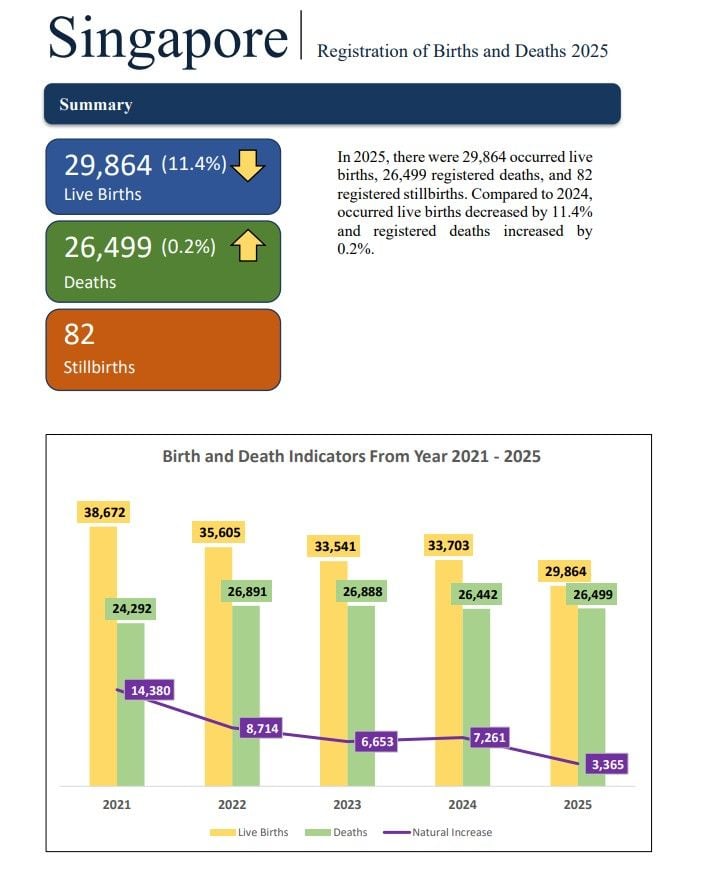
According to the Immigration and Checkpoints Authority's (ICA) Report on Registration of Births and Deaths 2025, released on 27 July 2026, a total of 29,864 live births were recorded last year, down 11.4 per cent from 33,703 births in 2024.
The figure marks the first time annual births have fallen below the 30,000 mark since 1965, when 55,725 babies were born.
Meanwhile, registered deaths edged up 0.2 per cent to 26,499 in 2025 from 26,442 a year earlier, reflecting Singapore's rapidly ageing population.
The report showed the country's natural increase — the difference between births and deaths — narrowed sharply to just 3,365 people in 2025, less than half the 7,261 recorded in 2024 and well below the 14,380 recorded in 2021.
Birth numbers continue long-term decline
Annual births have been on a downward trajectory for decades.
From the 1970s through the 1990s, Singapore typically recorded between 40,000 and more than 50,000 births annually.
Over the past two decades, births have generally remained below 40,000, before falling below 30,000 for the first time in 2025.
The report also showed the crude birth rate declined to 6.5 births per 1,000 residents in 2025, down from 7.4 per 1,000 residents a year earlier.
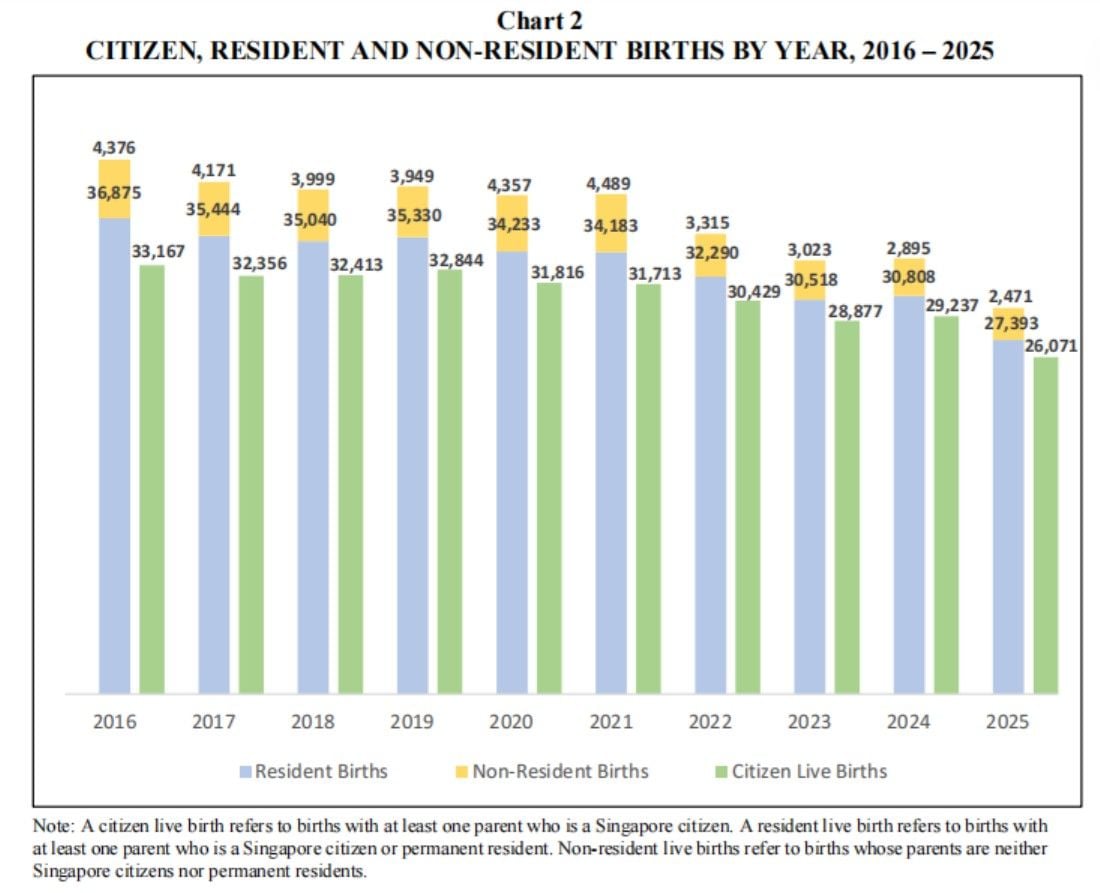
Of the babies born last year, 26,071 — or 87 per cent — had at least one Singaporean parent, while 27,393 births involved at least one Singapore citizen or permanent resident.
Among all newborns, Chinese babies accounted for 56.6 per cent of births, Malays 22.5 per cent, Indians 11.5 per cent and other ethnic groups 9.4 per cent.
First-time mothers continue delaying childbirth
The report showed Singaporeans continued having children later in life.
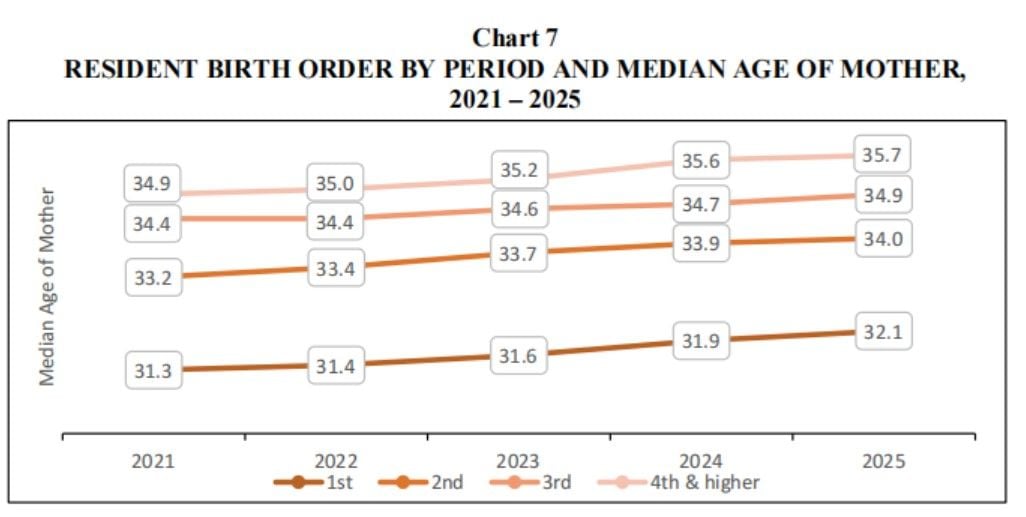
The median age of first-time mothers increased from 31.3 years in 2021 to 32.1 years in 2025.
Among ethnic groups, Chinese women had their first child at a median age of 32.9 years, followed by mothers from other ethnic groups at 32.5 years, Indian mothers at 30.9 years and Malay mothers at 28.8 years.
ICA said around two-thirds of first-time mothers in 2025 held university degrees.
Specifically, 67.7 per cent had university qualifications, while the remaining 32.3 per cent had A-level, diploma, Institute of Technical Education qualifications or lower educational attainment.
Only about one in 10 first-time mothers had O-level qualifications or below.
The trend of later marriages and delayed parenthood comes as Singapore continues grappling with declining fertility.
Earlier this year, Deputy Prime Minister Gan Kim Yong announced that Singapore's resident total fertility rate had fallen to a new low of 0.87 in 2025.
The total fertility rate refers to the average number of children each woman would have during her reproductive years.
Gan warned in February that Singapore's citizen population could begin shrinking by the early 2040s without further intervention.
He said supporting Singaporeans in forming families remained the Government's top priority, while stressing the need for a "carefully managed immigration flow to augment our low birth rate".
To address the issue, the Government established the Marriage and Parenthood Reset Workgroup earlier in 2026 to identify new measures to encourage marriage and parenthood.
Teenage births continue to fall
Despite the record-low birth numbers, several social indicators improved during 2025.
Teenage births fell sharply, with only 140 babies born to mothers aged 19 and below, representing a 43 per cent decline from 244 births in 2024.
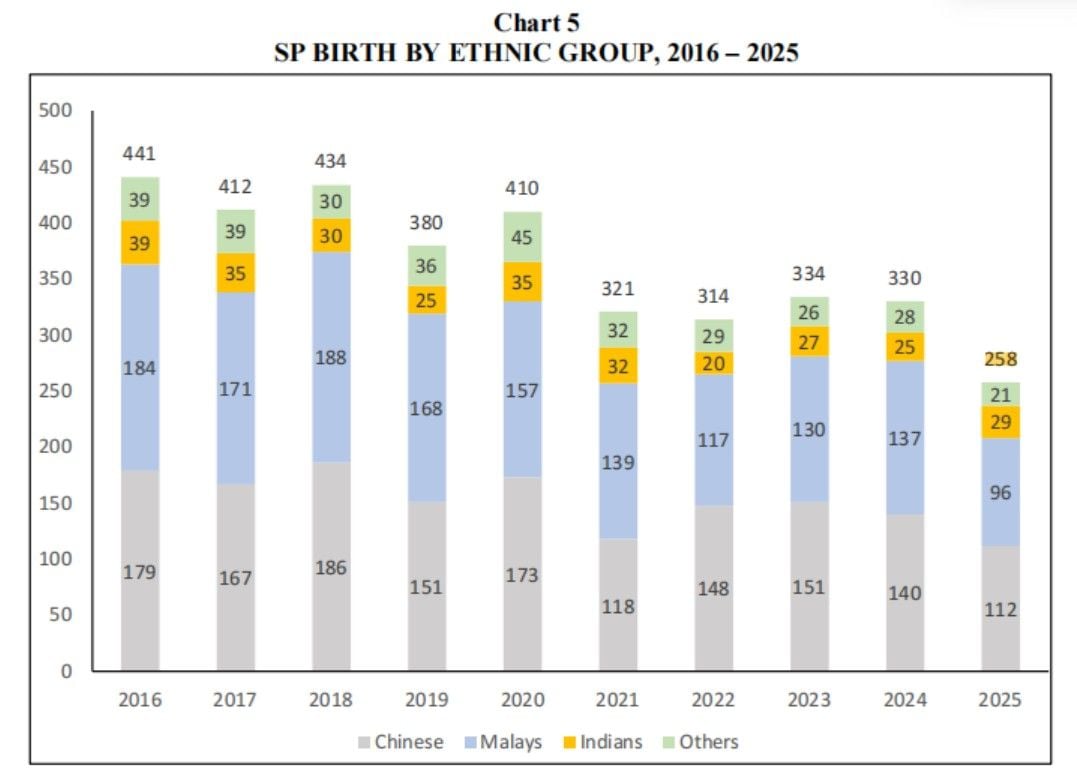
The report also showed 258 babies were registered without their father's name, down 22 per cent from 330 in the previous year.
Only 43, or 16.7 per cent, of these single-parent birth registrations involved teenage mothers aged 19 and below.
Meanwhile, birth order data showed nearly half of all babies born in 2025 were first-born children.
First-order births accounted for 47.5 per cent of all births, followed by second-order births at 35 per cent, third-order births at 11.8 per cent and fourth or higher-order births at 5.7 per cent.
Ageing population drives deaths higher
Singapore's ageing population continued to shape mortality trends.
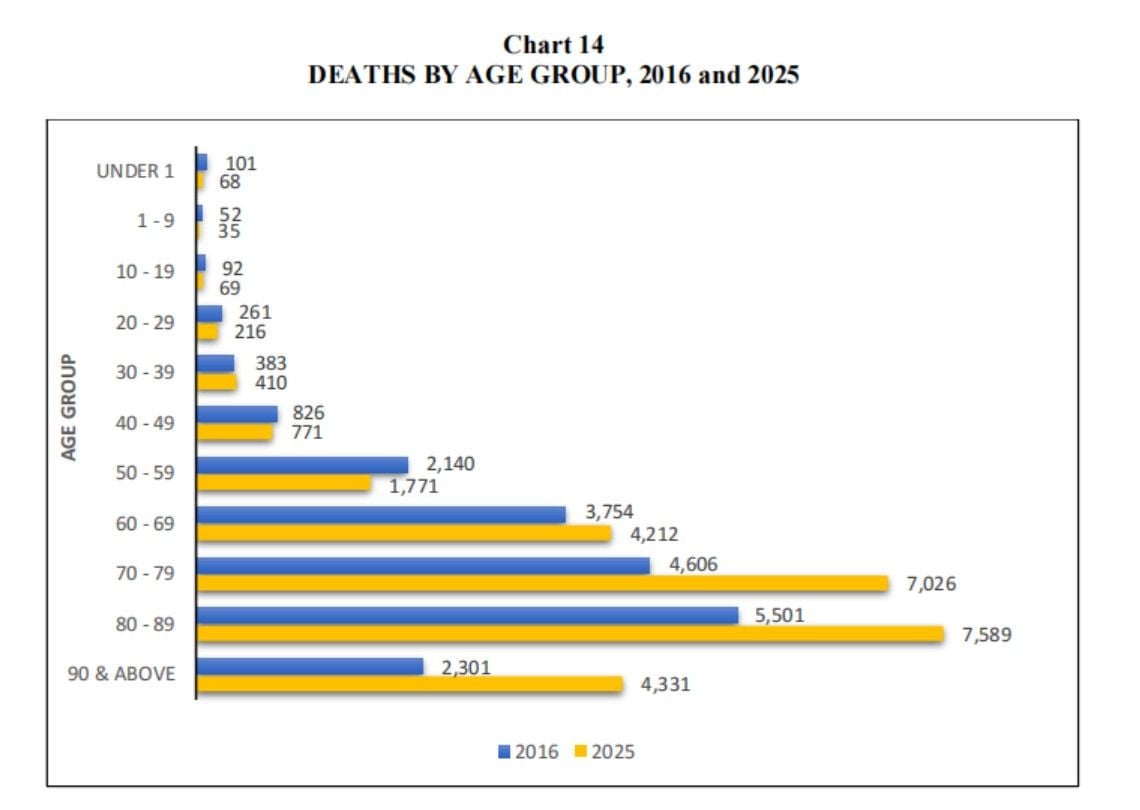
The report found 87.4 per cent of those who died in 2025 were aged 60 years and above.
The median age at death increased to 78.2 years in 2025 from 76.1 years in 2016, continuing a long-term upward trend.
Women continued to outlive men, with a median age at death of 82.5 years compared with 75.7 years for males.
Cancer remained the leading cause of death, followed by heart and hypertensive diseases.
Together, the two conditions accounted for 52.1 per cent of all registered deaths in 2025.
Lung and respiratory diseases made up a further 24.7 per cent of deaths, while cerebrovascular diseases accounted for 5.6 per cent.
The report noted that deaths from external causes, including accidents, suicides and other unnatural causes, represented only 2 per cent of all registered deaths.
Health indicators remain strong
Several health indicators continued to improve despite the demographic challenges.
Infant mortality declined from 79 cases in 2024 to 68 cases in 2025, reducing the infant mortality rate to 2.0 deaths per 1,000 resident live births.
Neonatal deaths also fell from 47 to 44 during the year.
The report recorded 82 stillbirths in 2025, down from 110 in 2024, while there was one registered maternal death during the year.
According to ICA, there were also 261 children adopted and registered or re-registered under the Registration of Births and Deaths Act 2021 during 2025.