Online petitions against Gillman Barracks and Maju Forest housing plans pass 40,600 endorsements
Online petitions opposing proposed housing developments at Gillman Barracks and Maju Forest have surpassed 40,000 endorsements, with 10 days remaining for the public to submit feedback to HDB before the 6 August deadline.
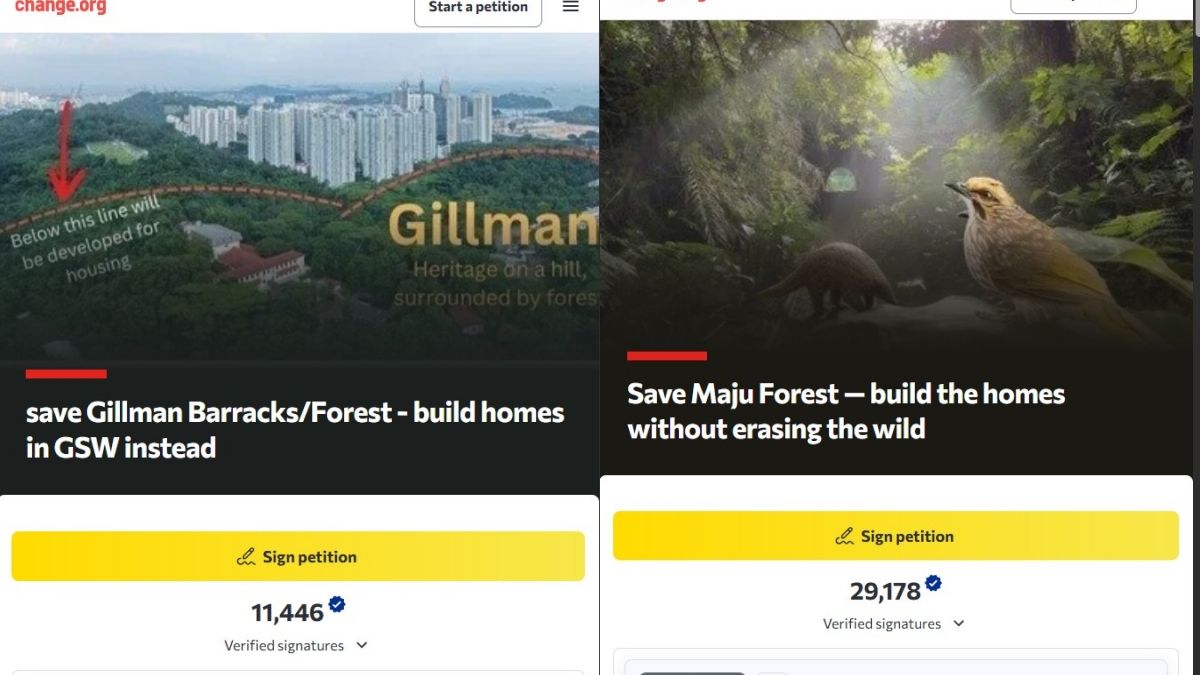
- Two online petitions opposing proposed developments at Gillman Barracks and Maju Forest have surpassed 40,600 combined endorsements.
- Campaign organisers are urging residents to submit official feedback before HDB’s public consultation closes on 6 August.
- Public engagement activities are planned for 30 July and 2 August as campaigners call for broader environmental review.

SINGAPORE: Online petitions opposing proposed housing developments at Gillman Barracks and Maju Forest have received more than 40,600 combined endorsements, as campaigners urge members of the public to submit feedback to the Housing & Development Board (HDB) before the 6 August 2026 deadline.
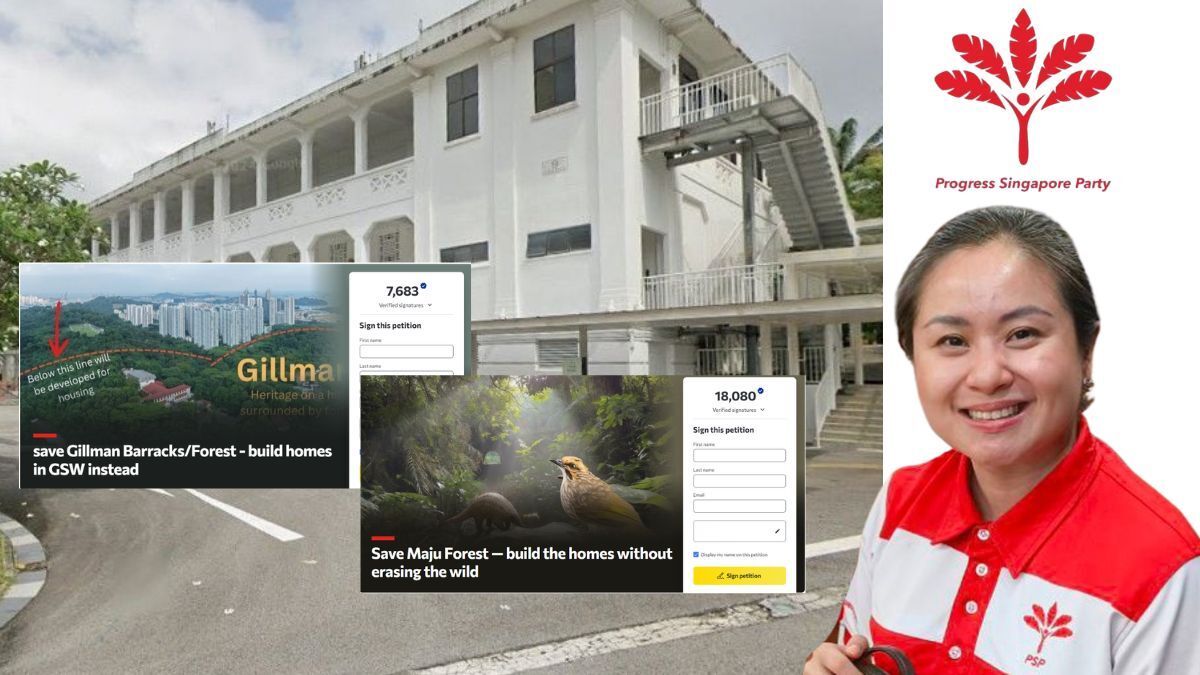
As of 4.30pm on 27 July 2026, the "Save Gillman Barracks/Forest" petition had attracted more than 11,440 signatures.
The "Save Maju Forest — Build the homes without erasing the wild" petition, launched on 11 July, had gathered more than 29,170 endorsements.
Campaign organiser urges official feedback before deadline; warning against incremental forest loss
In a 24 July update, Raymond Ong, organiser of the "Save Maju Forest" online petition, urged members of the public to participate in the official consultation process before it closes.
Ong reflected on the campaign's development over the preceding two weeks, saying the issue had grown into a national discussion but stressing that public awareness alone was insufficient.
Ong highlighted what he described as the cumulative impact of development on forest areas.
He pointed to about 3.6 hectares of Maju Forest that had already been cleared in 2024 for construction of the 1.2-kilometre Brookvale Drive, which serves a new condominium.
While acknowledging that the road was considered necessary, Ong argued that forests could be reduced through a series of projects that were individually considered justifiable rather than through one large-scale clearance.
With another 15 hectares now proposed for housing, he said individual developments might be assessed separately, while wildlife would experience the combined loss of habitat.
Ong said the campaign was not opposed to the construction of new homes, citing HDB figures showing that the recent Clementi Build-To-Order (BTO) exercise was more than four times oversubscribed.
Instead, he called for greater transparency before untouched forest areas are developed.
He urged authorities to publish details of alternative sites that had been studied, expected housing yields and the trade-off assessments behind the proposal.
He also called for consideration of whether existing developed land could be prioritised before forest areas are developed.
Save Gillman organiser calls for broader environmental review
In a 25 July update, Save Gillman Barracks/Forest organiser PT Tan similarly urged members of the public to participate in the consultation process before the 6 August deadline.
Tan encouraged residents to write to their Members of Parliament and submit feedback through HDB's official channel.
Tan argued that Gillman is "not an ordinary land parcel", citing what the campaign described as its ecological and heritage significance.
The organiser also called for a nationwide discussion about the area's future.
Tan questioned whether the current consultation involved all relevant government agencies.
While HDB and the Urban Redevelopment Authority oversee housing and land-use planning, and the National Parks Board (NParks) focuses on biodiversity conservation, Tan said the Ministry of Sustainability and the Environment (MSE) should also play a role.
According to Tan, MSE's responsibilities include sustainability, climate resilience and environmental liveability.
Tan also argued that the environmental impact assessment did not fully address wider considerations, including urban heat, stormwater management and air quality.
He noted that Gillman forms part of the Southern Ridges and borders an existing nature reserve, arguing that these broader environmental considerations should be included before decisions on development are made.
Public engagement session reaches capacity ahead of 30 July
Alongside the online petitions, a residents’ public engagement session hosted by Rachel Ong, MP for Tanjong Pagar GRC, is scheduled for 30 July at Telok Blangah Community Club, with registration and dinner at 7.30pm followed by the programme at 8pm.
Promotional material for the session lists the Housing & Development Board (HDB), Urban Redevelopment Authority and National Parks Board (NParks) among the organisations joining the gathering.
The session is intended for residents in the Telok Blangah Division, covering Depot, Dover, Pasir Panjang East and Telok Blangah.
However, a check of the event’s registration link showed that registration for the public engagement session had closed after reaching its stated capacity of 350 participants.

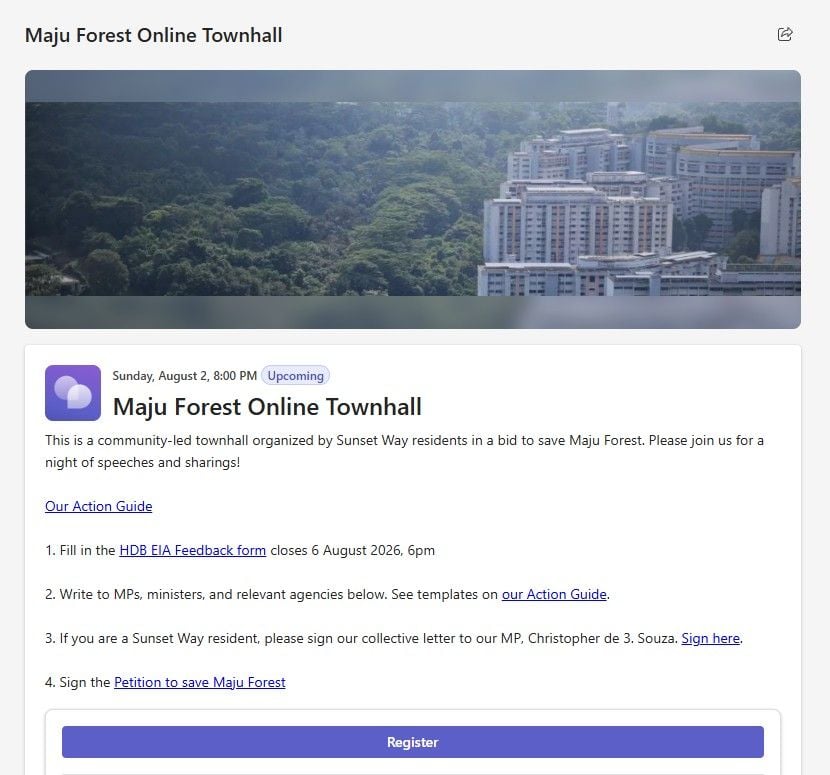
Separately, a community-led online townhall organised by Sunset Way residents is scheduled for 2 August at 8pm as part of efforts to oppose the proposed development at Maju Forest.
HDB says Sunset Way housing plans remain under review
The community events come after HDB announced on 10 July that it intended to develop new homes at Gillman Barracks and the Sunset Way site in Clementi.
On 17 July, HDB chief town planner Dr Chong Fook Loong, who is also group director of the agency’s urban planning division, said the proposed public housing development at Sunset Way was not final.
He said HDB was seeking to balance residents’ concerns over Maju Forest with Singapore’s housing needs.
"We have to make trade-offs. We have to understand how to balance housing and nature to bring about the best plan, as we always do wherever we go," Dr Chong said.
He said strong demand for public housing meant HDB had to consider sites beyond previously developed land.
Referring to the recent Clementi Build-to-Order exercise, Dr Chong said applications exceeded the available flats by more than four times, demonstrating sustained housing demand.
He added that HDB had prioritised brownfield sites wherever possible, but suitable land within Clementi and neighbouring areas had become increasingly limited.
"So, we have to now focus on Sunset Way site to see how that can help to enhance the supply," he said.
Dr Chong also said planning for the Sunset Way site had been guided by an Environmental Impact Assessment, which identified biodiversity features that would help shape development decisions.
"That plan is not final. We are working on it... through these plans and through these trade-offs, we hope to work further with residents and stakeholders," he said.
HDB outlines proposed environmental safeguards
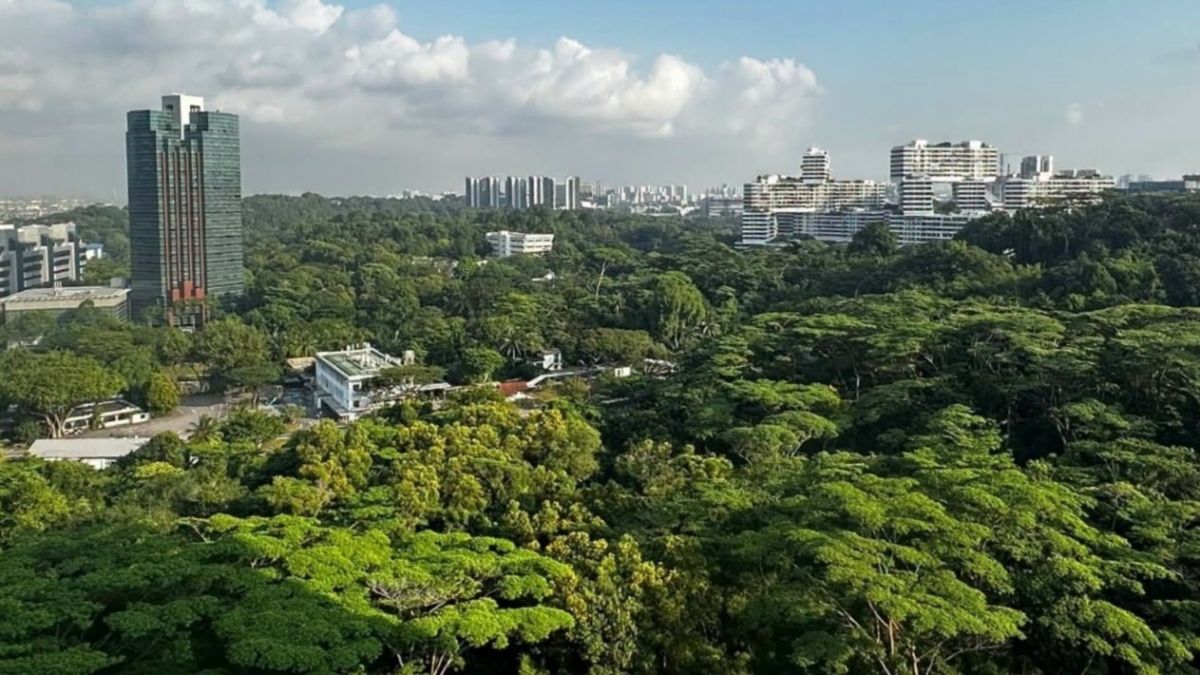
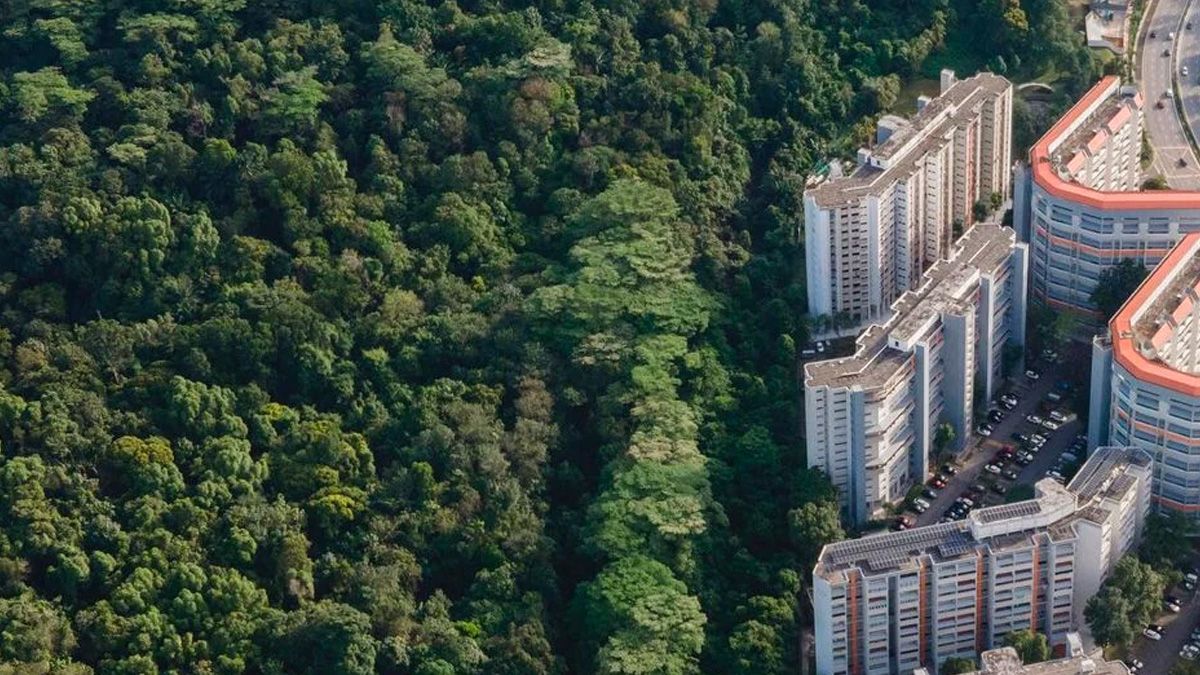
Under HDB’s current proposal for the 23-hectare Sunset Way study area, about eight hectares, mainly along the forest edges, would be retained, while the remaining land would be developed for housing.
HDB has said its proposed developments at Gillman Barracks and Sunset Way were informed by detailed environmental and heritage studies.
The agency said findings from the studies, together with public feedback submitted by 6 August, would help shape final development plans, including housing yield, flat mix, project classification and development timelines.
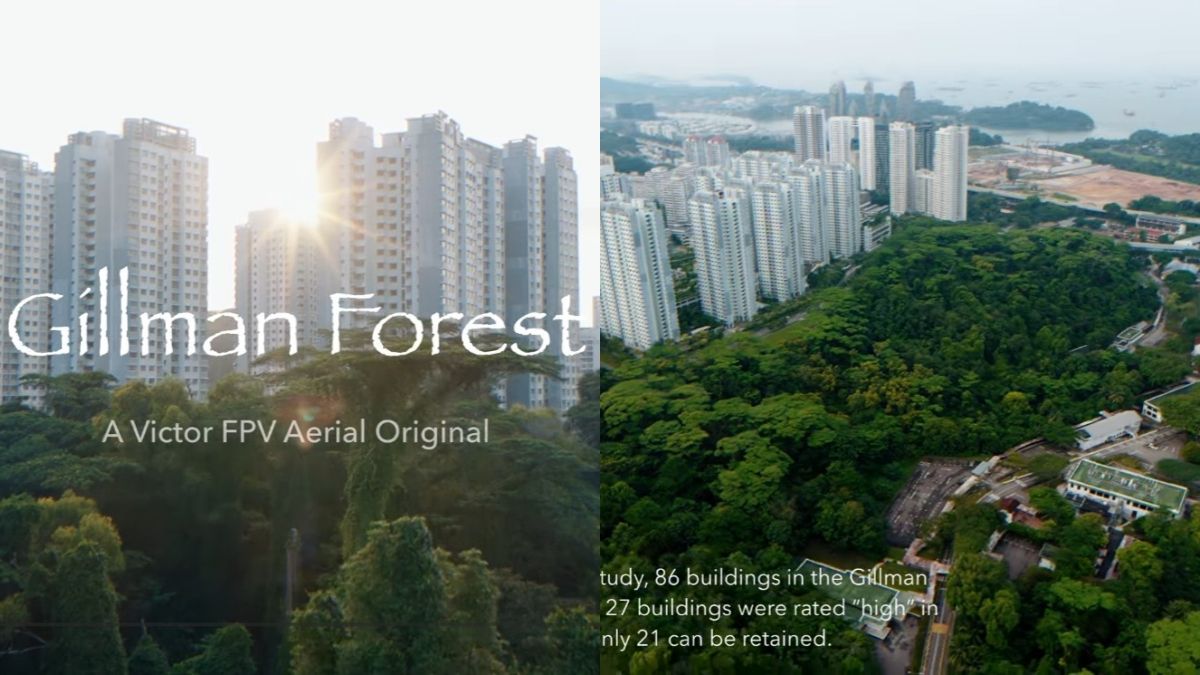
At Gillman Barracks, HDB plans to build public and private homes near the Greater Southern Waterfront while retaining more than 20 of the site’s 86 heritage buildings.
The proposal also includes preserving most of the existing secondary forest, a natural forest stream and ecological corridors.
Environmental surveys identified 293 plant species and 178 fauna species at the site, including 33 species of conservation significance.
HDB said the plans include ecological corridors at least 30 metres wide, about eight hectares of connected green space and phased vegetation clearance to minimise impacts on wildlife.
Four heritage clusters are also proposed for retention, with the potential to adapt them for commercial and community uses.
At the 23-hectare Sunset Way site, HDB said the proposed estate would provide additional housing options in western Singapore while incorporating biophilic landscape design featuring native plant species.
About eight hectares, including a natural freshwater stream and areas along the former Old Jurong Line, would be retained as wildlife habitat and connected to a proposed nature trail.
The two petitions continue encouraging members of the public to submit feedback before the consultation closes on 6 August and to write to their MPs calling for greater transparency, consideration of alternative sites and protection of Maju and Clementi forests as a connected ecological corridor while addressing Singapore’s housing needs.