
GIC's 20-year annualised real return fall to six-year low as fund cuts risk amid global uncertainty
GIC's 20-year annualised real return fell to 3.4% in FY2025/2026, its lowest in six years, as the sovereign wealth fund reduced risk and prioritised resilience while preparing for a more uncertain investment environment.
- GIC's 20-year annualised real return fell to 3.4%, reflecting a more defensive approach focused on resilience and diversification.
- The sovereign wealth fund is refreshing its investment framework to enable more flexible capital allocation across equities, fixed income and real assets.
- GIC is targeting long-term AI opportunities while planning an additional US$30 billion in hedge fund investments over three years.

Singapore sovereign wealth fund GIC recorded a 20-year annualised real rate of return of 3.4% for the period ended 31 March 2026, down from 3.8% a year earlier, as it prioritised portfolio resilience and took less risk amid a more uncertain investment environment.
The latest figure, announced on 24 July 2026, was the lowest since the 2.7% recorded for FY2019/2020.
GIC's annualised nominal return over the 20-year period was 5.6% in US dollar terms. The fund said this was equivalent to adding 3.4% a year above global inflation to the international purchasing power of the reserves under its management.
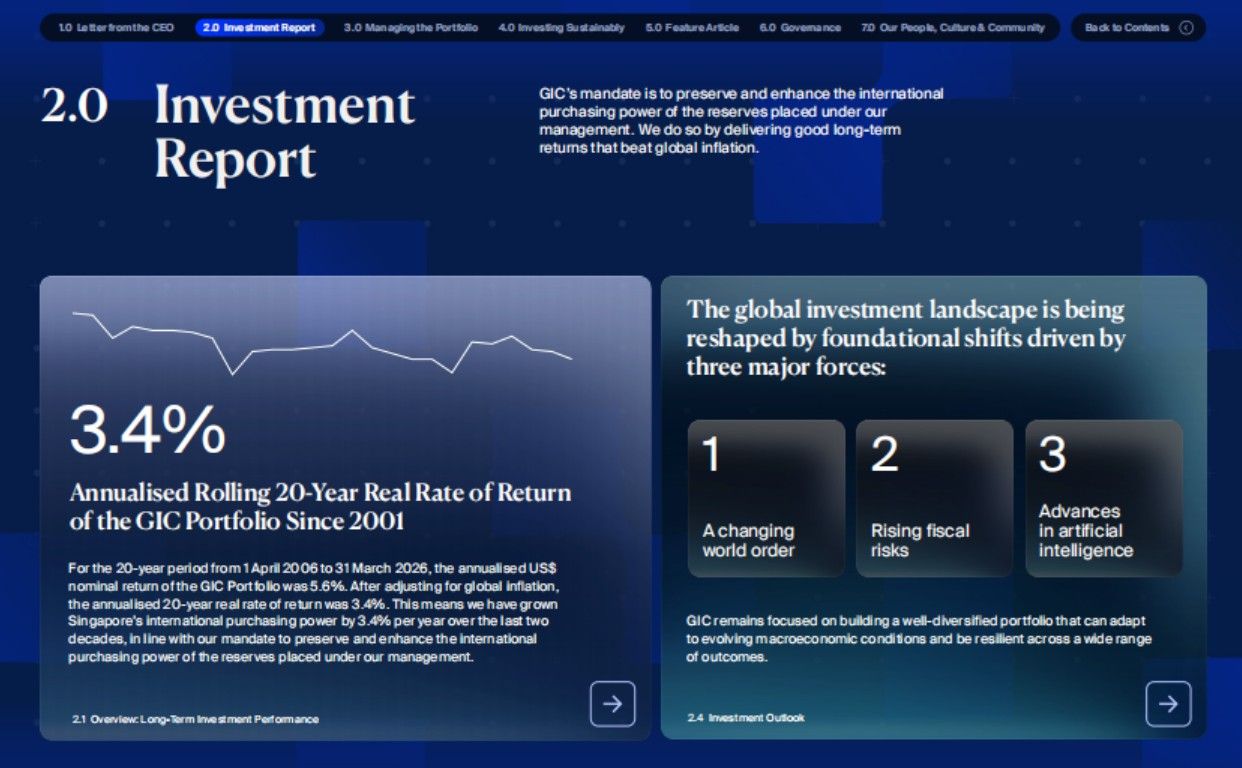
The rolling 20-year real return remains GIC's primary performance measure. The latest calculation covers 1 April 2006 to 31 March 2026, with the year ended 31 March 2005 dropping out of the measurement period.
GIC stressed that the metric is a rolling measure, meaning changes can be affected by both the latest year entering the calculation and the earliest year dropping out. The return is also calculated on a time-weighted basis, net of management costs and fees.
The fund said its long-term performance remained consistent with its mandate to preserve and enhance the international purchasing power of Singapore's reserves.
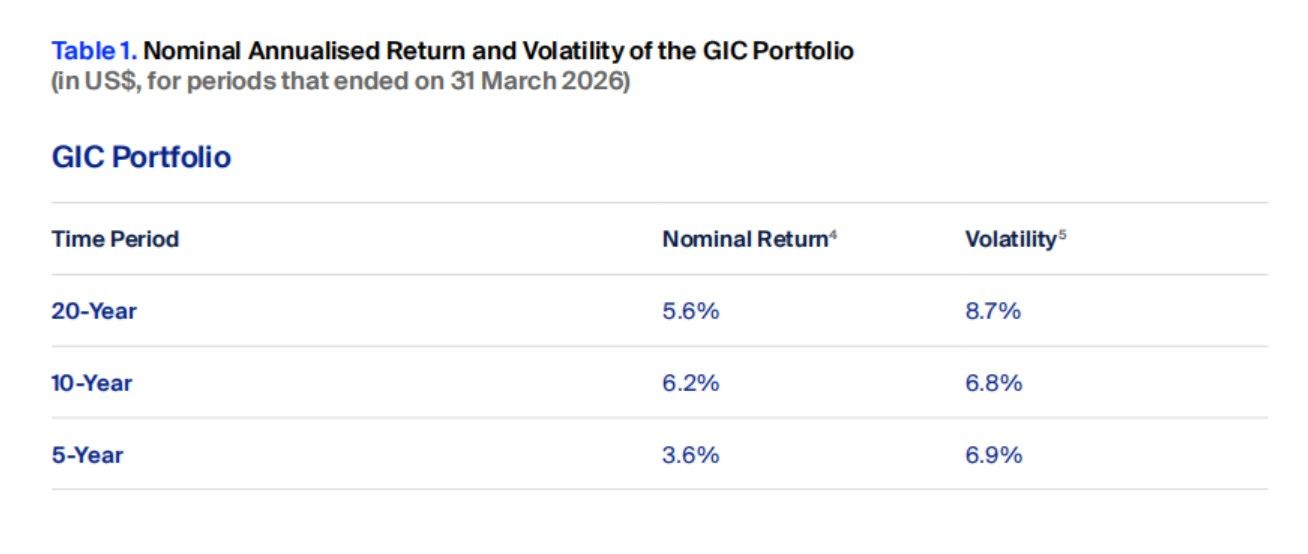
The report also showed that GIC's nominal US dollar return was 6.2% over 10 years and 3.6% over five years. Portfolio volatility was 6.8% over 10 years and 6.9% over five years, compared with 8.7% over the 20-year period.
GIC said the investment environment over the past decade had changed significantly, moving from a period of near-zero interest rates, stable inflation and relatively low volatility to one shaped by the pandemic, geopolitical realignment, renewed inflation, tighter monetary policy and rapid technological change.
It said its decision to increase portfolio resilience through diversification and a lower-risk profile had reduced overall returns, but had also helped protect the portfolio against downside risks.
"This moderated returns, but it is consistent with our long-term mandate: it gave us greater downside protection and more flexibility to act on opportunities as they emerge," Chief Executive Officer Lim Chow Kiat said.
Portfolio shifts towards equities and real assets
The latest report provides a clearer picture of how GIC has adjusted its portfolio in response to the changing environment.
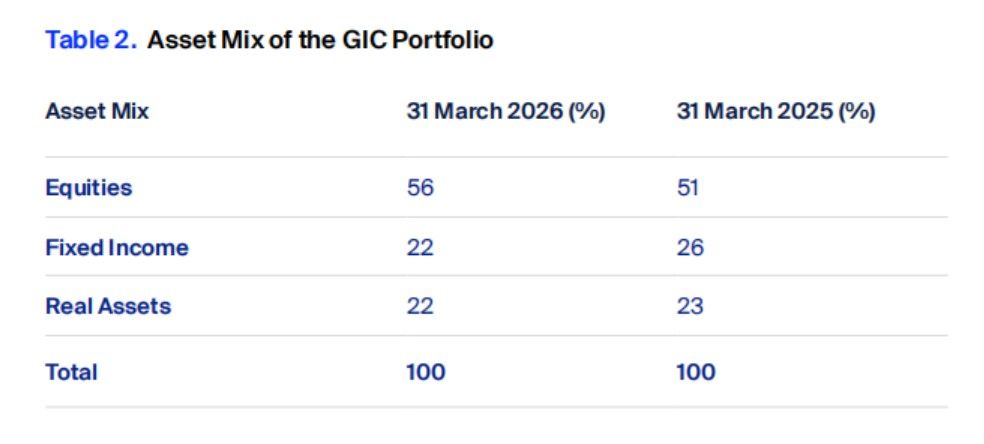
Equities accounted for 56% of the portfolio at 31 March 2026, up from 51% a year earlier. Fixed income fell to 22% from 26%, while real assets edged down to 22% from 23%.
GIC said the increase in equities included greater investment in the US, which remained its largest investment market.
Greater investment in US
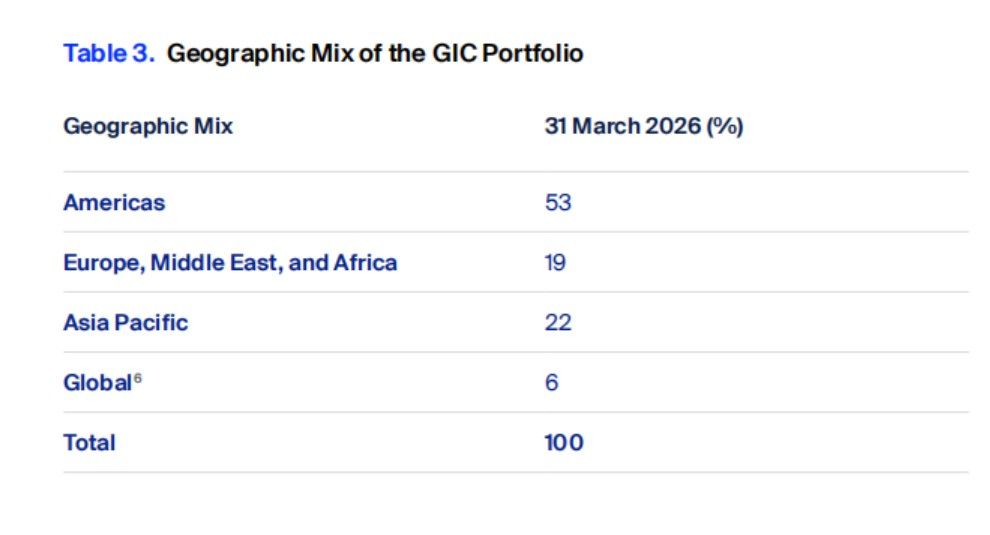
The portfolio's geographic exposure was 53% in the Americas, 19% in Europe, the Middle East and Africa, and 22% in Asia Pacific. A further 6% was classified as global, covering funds, commodities and supranational debt instruments without specific geographical allocations.
The fund said it had also increased allocations to commodities, gold and infrastructure to strengthen inflation resilience.
Gold, in particular, has become a more prominent structural diversifier in GIC's assessment of the investment environment. The annual report said gold prices reached record highs on 44 days during the financial year and exceeded US$5,000 per ounce in early 2026.
GIC said the development reflected a broader change in how investors view gold, with the asset increasingly seen as a potential hedge against geopolitical and fiscal risks.
A structurally different investment environment
GIC's assessment of the global economy is centred on what it identifies as three major forces: a changing world order, rising fiscal risks and advances in artificial intelligence.
The fund said geopolitical risks were increasingly structural rather than temporary disruptions.
Countries were placing greater emphasis on resilience and strategic autonomy, reshaping supply chains and capital flows through industrial policy, export controls, tariffs and other forms of economic and financial statecraft.
GIC said these changes were colliding with physical constraints in computing power, critical minerals and energy.
It also warned that high public debt levels were narrowing governments' fiscal room, while rising competition for global savings could push up long-term yields.
The report said this environment required greater caution around the traditional role of sovereign bonds as portfolio diversifiers, particularly if inflation remains elevated and bond-equity correlations rise.
GIC said it was responding by diversifying not only across asset classes and geographies, but also across underlying sources of risk and return.
These included investments with durable cash flows, low correlation with traditional markets and structural demand less dependent on broader economic conditions.
The fund cited intellectual property rights and music royalties as examples, alongside gold and inflation-resilient real assets.
AI opportunities and risks
Artificial intelligence remains a major investment focus, but GIC said the technology's rapid development was making it harder to identify long-term winners.
Group Chief Investment Officer Bryan Yeo said AI investment required a more granular approach because adoption was uneven across industries, geographies and companies.
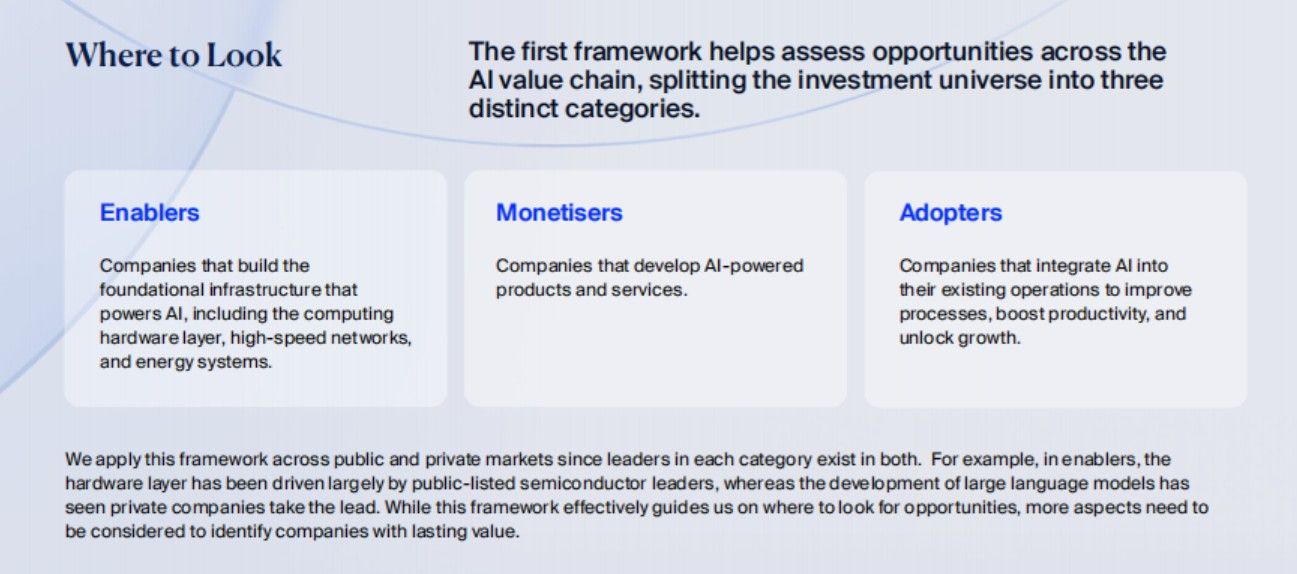
GIC divides the AI ecosystem into three categories: enablers, monetisers and adopters.
Examples of enablers include Vantage Data Centres and Anthropic, while Databricks and Ramp are among the monetisers. Athenahealth and Eli Lilly are examples of adopters.
Yeo said GIC's early investments were concentrated in enablers before shifting towards monetisers.
"We think that in the coming few years, there will be a lot of value creation in the adopters space," he said.
The annual report said the fund had developed early conviction in hyperscalers and core AI infrastructure, while targeting bottlenecks in advanced semiconductor manufacturing and design.
It is also investing in the physical infrastructure required to support AI, including power, electricity grids and cooling capacity for data centres.
GIC warned that the distribution of AI-related value remained uncertain, with large language models consolidating around a small number of frontier players while commoditisation risks increased elsewhere.
It also said AI could create a wider gap between companies that successfully harness the technology and those that are disrupted.
In software, for example, AI-powered coding tools could reduce development costs and challenge traditional software-as-a-service pricing models. However, GIC said businesses with deep customer integration, proprietary data and mission-critical workflows could remain resilient.
Yeo said GIC assesses its AI exposure at the overall portfolio level, including the correlation between investments.
"We ask ourselves: Do we have too much? Do we have too little? Do we have just right?" he said.
He also cautioned that non-AI opportunities could be overlooked as investor attention concentrates on the sector.
"For a long-term investor, if you look out 20 years, you don't want to have everything in just AI alone," he said.
A new framework for a more volatile world
GIC began transitioning to a refreshed investment framework on 1 April 2026, replacing the framework introduced in 2013 following a comprehensive review in 2012.
Under the previous framework, the Reference Portfolio represented the Government's risk appetite, the Policy Portfolio set strategic asset allocation, and the Active Portfolio sought to generate additional returns through skill-based strategies.
The refreshed framework introduces a Strategic Portfolio representing the Client's risk appetite and long-term return expectations.
It groups investments into equities for growth, fixed income for income and real assets for inflation resilience.
The change is designed to give GIC greater flexibility in allocating capital according to the underlying drivers of returns rather than being constrained by traditional asset-class boundaries.
For example, the equities grouping will no longer restrict allocations between public and private equity through separate ranges, allowing GIC to pursue growth opportunities across both markets.
The fixed-income grouping provides greater flexibility to adjust allocations across different types of fixed-income assets as interest-rate conditions change.
Real assets can also be diversified across physical assets to strengthen protection against inflation shocks.
The GIC Portfolio will continue to use active strategies, private equity and other alternative investments to seek returns above the Strategic Portfolio over the long term, within approved risk parameters.
Its portfolio construction will remain guided by three principles: diversification, granularity and agility.
GIC said its active strategies are subject to rigorous risk assessments and stress tests covering extreme but plausible macroeconomic and geopolitical scenarios.
The fund's chief executive said the new approach reflected a world that had "fundamentally changed", as well as capabilities GIC had developed in active investing, private markets and strategic partnerships.
"We will continue to focus on active investing which requires the judgement to allocate capital well and with granularity, the discipline to stay diversified, and the agility to act when good opportunities arise," Lim said.
The report also said GIC's new framework would support greater use of its private-market capabilities and value-creation expertise, while allowing it to respond more quickly to market dislocations.